
So, I Guess We Use AI to Talk to Each Other Online Now
What happens when comments, replies, and internet conversation become machine-assisted

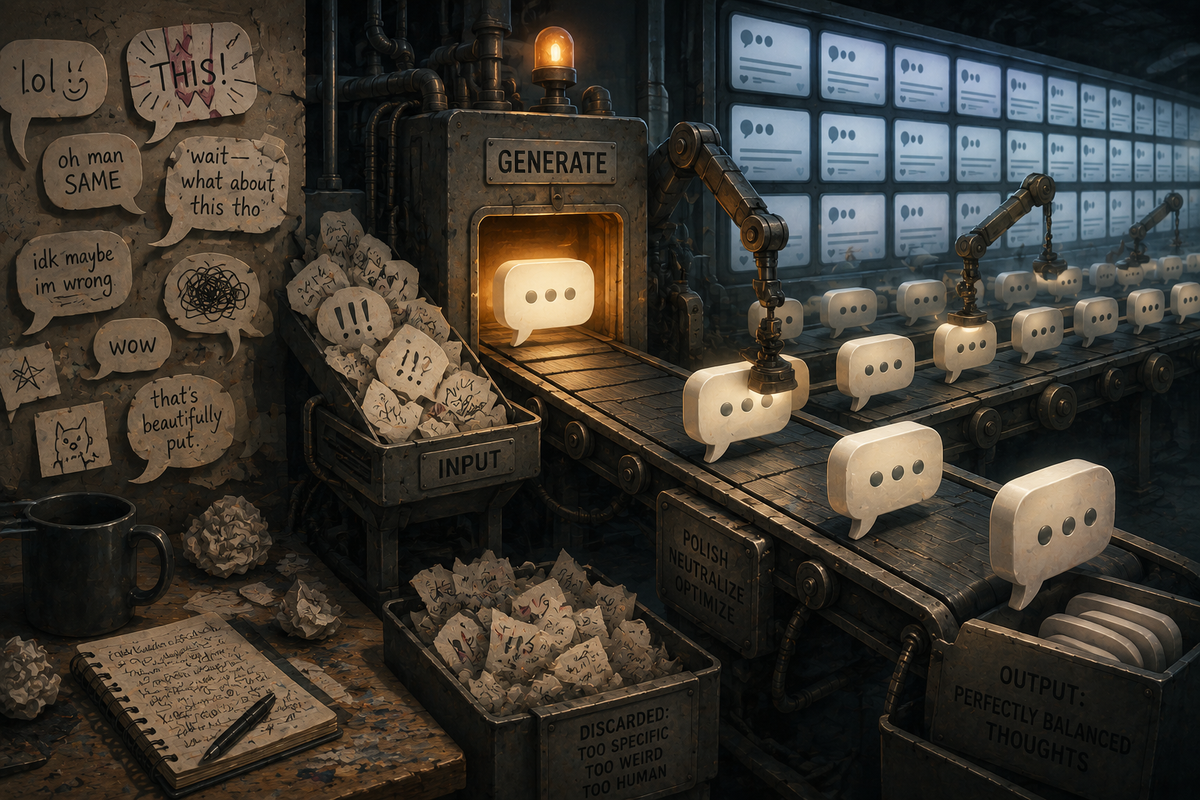
The other day, something happened that I'm seeing more often on the rare occasion people actually go out of their way to engage with my stuff. Someone commented on something I wrote, but the comment immediately gave me that uncanny valley feeling.
It wasn’t rude or anything. It was actually everything a "good" comment ought to be — thoughtful, articulate, emotionally astute, a solid length, and very carefully balanced. It was the internet equivalent of a lightly steamed organic hors d'ouevre placed strategically on a wooden serving board, in fact.
Last time I checked, though, the average e-person is still more of a spray-cheese-and-crackers kind of person.
The response technically engaged with the points I was making. But the commenter also did things like reference a lot of very specific imagery from my article in a way that felt unnatural, like the person was trying too hard to show just how carefully they'd read.
It felt like something a machine would spit out in response to the post, and I fully realize that's probably exactly what it was.
I’m seeing this type of thing everywhere online now. Substack comments, Medium replies, LinkedIn posts written in that eerily calm “I appreciate this perspective” cadence that literally no human anywhere actually embodies.
What I don't entirely get is why. Because I see why people might use AI to help them write something organized and structured, like an article or a whitepaper. But if you don't actually have anything spontaneous to say in a quick comment you want to leave, why bother commenting at all?
The Internet Rewards "Finished" Communication
I suppose part of this is an inevitable reaction to the kind of internet we’ve built over the years. Modern online spaces reward mirror-perfect polish, which means the pressure is on everyone to sound:
- Informed
- Nuanced
- Emotionally intelligent
- Socially calibrated
- Impossible to screenshot out of context
Plus, we're all performing in front of an invisible audience now, whether we actually like that or not, so even casual interactions have started to feel weirdly public. That's bound to change how people communicate.
Years ago, internet conversations usually felt gloriously uneven. There was always the off chance someone might spew a full-blown emotional breakdown into a LiveJournal comment section at 1:40 AM while listening to Bright Eyes and eating shredded cheese directly from the bag, and I loved that.
But today, most online spaces feel too sterile for that. Responses are way more audience-aware. AI fits naturally into that ecosystem because it excels at producing communication that sounds polished and complete.
Exactly what today's internet apparently wants, demands, and rewards.
Why People Use AI to Write Comments in the First Place
I don’t actually think most people use AI for this purpose because they’re truly trying to deceive anyone. It's more like AI has become emotional Spanx for communicating online in any context.
Today's internet can feel pretty brutal if you're the sort to worry much about how you come across. People are constantly concerned about sounding:
- Stupid
- Cringe
- Insensitive
- Uninformed
- Accidentally embarrassing in a searchable way
AI offers those people the rhetorical insurance they're looking for.
A person can feed their favorite AI engine something like “I mostly agree with this article, but think it overlooks economic pressure.” Then they get a polished response, complete with excellent emotional posture and conflict resolution tact for their trouble. Much easier than simply rolling the dice and hoping you sound OK.
Don't even get me started on how performative even simple online conversations have become.
Comments aren't spontaneous reactions anymore. Instead, they need to function as tiny public-facing essays that make the commenter sound intelligent, reasonable, emotionally mature, lightly funny, morally stable, and casually well-read at the same time.
Plus, people are so fried right now. Most brains, my own included, currently operate like browser windows with forty open tabs and mysterious music playing from somewhere nobody can locate. A lot of people genuinely still have thoughts and enjoy connecting the way they used to, but they also lack the energy to shape every response from scratch while also surviving everyday life.
AI lowers the activation energy of participation. And although I'm the furthest thing from an AI hater, I'm aware of how extremely dystopian that sentence sounds.
Hate that for us.
How to Navigate All This Without Losing Your Mind
I don’t think the solution here is the paranoia I'm seeing elsewhere. I do think all this changes how online interaction feels on a level that probably calls for different expectations moving forward.
Stop expecting every expectation to feel as human as it used to
Because truth be told, it's never going to ever again. It's just a given that at least some comments now involve factors like:
- Light AI polishing
- AI-assisted drafting
- Partial rewrites
- Full generation
- Hybrid collaboration
That’s simply part of online life now, whether we like it or not. Raw spontaneous expression is a thing of the past for some people, and that's just the way it is.
Look past polish and focus on presence
The most meaningful interactions still feel at least a little messy and unpredictable. They're also full of lived experience, personality, and strange little irregularities.
Real people leave fingerprints all over communications when they aren’t busy food-milling themselves into corporate oatmeal, and as far as I'm concerned, that’s the good stuff.
Don't outsource your entire voice
I don't think using AI for assistance is inherently bad. I personally find it useful for a lot of things, and I assume so do a lot of people these days, whether they're honest about that or not.
The problems start when someone decides to hand over their entire communication system to a machine and start spewing professionally moisturized prose everywhere as a result.
Because real people connect with things that still feel at least a little rough around the edges. And they fall in love with creators who aren't afraid to say something slightly odd in the right way at precisely the right moment.
I Think We'll Eventually Miss the Awkwardness
That comment this person left on my article the other day really got me thinking about how thoroughly we all used to live inside imperfection online. The conversations we all used to have were packed with:
- Weird oversharing
- Emotional messiness
- Accidental comedy
- Abrupt tangents
- Uneven energy
- People typing “sorry this is so long lol” right before posting fourteen emotionally devastating paragraphs about a breakup
The internet felt a little unhinged at times as a result, but it also felt fully inhabited by people who were being authentic on a level I didn't really see in Meat World. In contrast, today’s internet increasingly feels overly optimized and faintly machine-laundered around the edges. (Seriously, I can smell the fabric softener.)
It's all getting a little spiritually airless.
That said, I know people will always find ways to insert themselves into their go-to language eventually. We’re much too strange and wonderful as a species not to. But I also suspect a lot of us are going to spend the next few years rethinking what it means to "show up" online now that AI is a regular part of the chat.
Because perfectly optimized comments often feel so empty. On the other hand, a messy paragraph or two typed by somebody sitting cross-legged in bed while eating dry cereal straight from the box still sometimes contains more actual humanity than an entire page of "flawless."
I hope we don’t lose sight of that.