What I Kept, What I Threw Away, and Why It Mattered
On cleaning out our house, reclaiming a space, and choosing the present

So, as you may be aware, we've been in the middle of a major home project since just before Christmas or so. We're finally coming to the end of it all with just a few fairly approachable tasks left to do, and I'm realizing I have some feelings about all that — some pretty great and others a little stranger or more confusing.
Because two months ago, I really thought getting to the end of all this would feel more like a grand finale. Think trumpets, sparkles, and me standing in the middle of a gleaming room whispering, “Behold.”
Instead, it felt a lot more like someone handed me a quiet, echoing building and said, “All right. Now, live in it.”
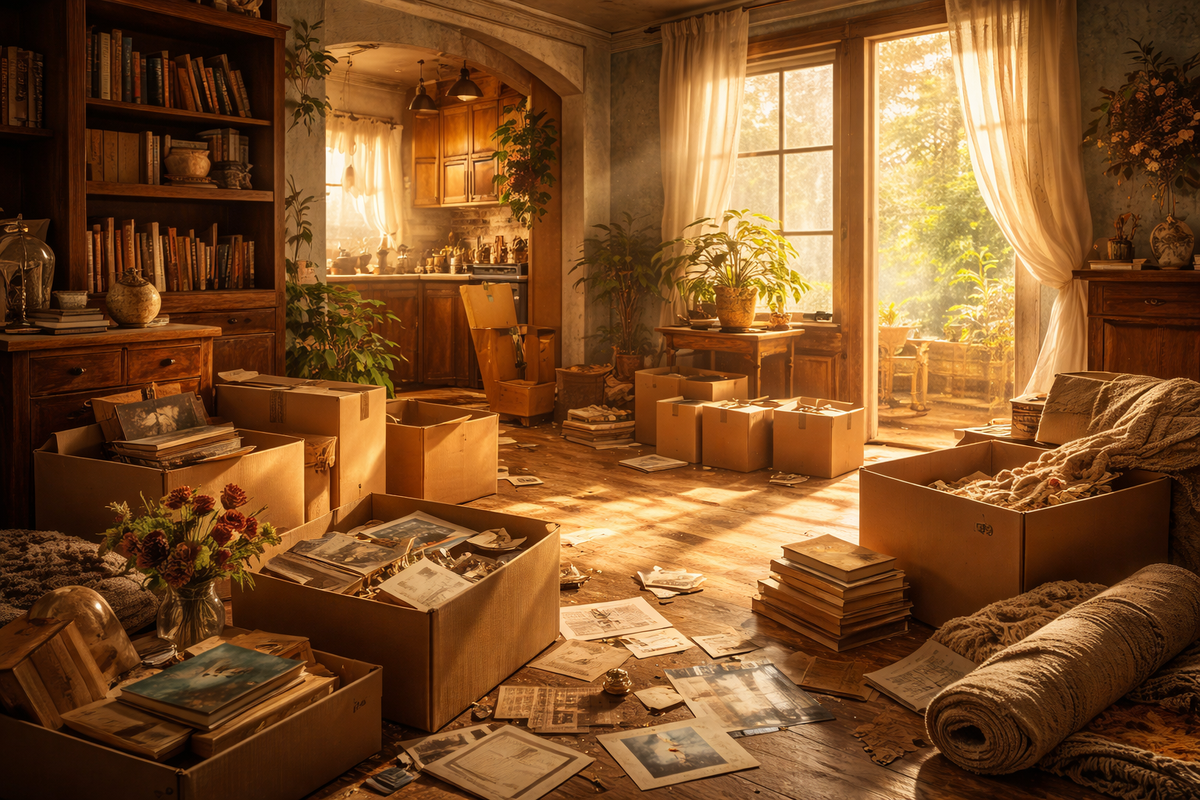
Once the contractors packed up for the most part and the dust finally stopped performing interpretive dances in the sunlight, it kind of felt like the house was just standing there, spacious and more than a little bit stunned. I’d spent so long navigating around mess and disruption that I hadn’t actually considered what it would feel like to exist without it.
Turns out, the space you're left with after an experience like that has a whole-ass personality all its own. And it expects your active participation.
The Museum of Former Me
Deep-cleaning a house at this level has ultimately felt a lot less like tidying and more like touring a very specific museum with my name over the front door — The Many Phases of You.
Each box was like an exhibit, and each drawer was a curated archive. Like, here's a box full of random stuff, throwing all the way back to the era when I thought I would reinvent my entire life around some overly specific aesthetic. Here's another one, apparently full of a version of me who purchased things with the confidence of someone convinced she had it all figured out.
She sure as fuck did not.
I've also been thinking about how objects are truly excellent time capsules. They hold onto stale enthusiasm (not to mention other dead or dying feelings) long after you’ve moved on.
Some of the things I dug up still felt aligned with who I consider myself to be these days. But others felt like props from a play that closed years ago, right after flopping badly. I guess I've tried on my share of identities over the years. Most of them weren't a terribly great fit, and almost all of them belonged in a completely different production than the one I'm starring in now.
Deciding what was going to stay and what absolutely needed to go was a real experience, though.
Editing Instead of Enduring
Editing your own life calls for a lot of intention, not to mention self-awareness you may not have on the level you like to hope you do. It certainly asks better questions than “Does this spark joy?” It's way more like, “Does this still reflect who I am?”
For example, I found a ton of unfinished projects from various eras of my life and had to confront the realization that most were less about creativity and more about struggling to figure out who I was. I examined furniture that carried emotional history along with its aging, tired, or even ruined upholstery. I evaluated objects that once symbolized ambition and now simply took up a lot of space that would be better given to something else.
Life in this house (especially when you consider the fact that I grew up here) came with a lot of physical baggage. Eventually, it also accumulated mess and clutter that I was just too tired and depressed to stay on top of anymore. And unfortunately, I adjusted to all that. I just stepped around all the detritus after a while and told myself I'd deal with it eventually. Someday.
Mindful editing interrupted that cycle, though, and it was about time.
Keeping something actually became a choice, as did deciding to throw away something else. Rearranging rooms started making me feel like I was actually rewriting parts of my own existence (but in a good way).
And yes, it’s very funny to discover that personal growth sometimes looks like standing in an old pair of black leggings, having a philosophical mental conversation with a throw pillow.
The Shock of Empty Space
A room that used to be filled with towering piles of absolute crap feels really different once all that's gone. A surface without stacks becomes something you can actually use, and silence amplifies itself when it has plenty of room to move (especially in rooms that don't have carpets in them anymore).
That takes some getting used to. So, for a while, I didn't do a whole lot beyond admiring the new floors.
I certainly appreciated the lack of chaos, but I also half-expected someone to appear and tell me I’d wandered into someone else's house. (Don't even get me started on how the beaten-down version of me low-key expected someone to appear at any moment and tell me I don't get to keep my new floors or the brand-new big-screen TV we ordered for our bedroom after all, because reasons.)
Then something finally stopped skipping and shifted.
I set up my office intentionally, witchy spiritual altar space and all. My new desk was something I deliberately chose — the first real desk I've ever actually owned — and it went where I actually wanted it to be. The shelves held only what I chose. My tarot decks, and notebooks, and strange little objects finally found homes that felt deliberate instead of incidental.
I wasn’t cleaning anymore at that point. I was moving in, really for the first time since I lived here with my mother as a wide-eyed teenager. Because there’s a difference between surviving inside a space and deliberately inhabiting it.
Inheritance and Choice
Every house carries a history, and I'm learning that every person does too.
Some of what I sorted belonged to me, but a whole heck of a lot belonged to other people’s expectations instead. Some things were only still around because I’d never paused long enough to ask whether they should stay.
Cleaning this place out forced me to finally make those decisions:
- Which habits do I actually want to keep moving forward?
- Which atmospheres feel supportive instead of suffocating?
- Which versions of myself deserve to stay here, and which am I so much better off without?
Because you inherit more than furniture. You also inherit tolerances for discomfort, ideas about what counts as normal, and suspiciously sticky narratives about endurance and obligation.
Reclaiming a space challenges those inheritances and invites you to choose consciously again.
Somewhere in the middle of all that seriousness, I found myself grinning at how long it took me to arrive here. Seriously, we're talking years of adapting and stepping sideways, eventually without questioning it anymore. But this cleanout and reset taught me that it's never too late to rearrange everything.
Apparently, the revolution begins with a broom, and that suits me just fine at this point in my life.