The Dresses Waiting Upstairs
For years, two impossible gowns wait patiently for the woman who made them

The dressmaker had long since abandoned the habit of asking questions, and with good reason.
Questions had a way of complicating otherwise interesting matters. They also invited explanations that carried an unfortunate tendency to diminish life's wonder. And after four decades spent sewing garments on the outskirts of a town that rarely appeared on maps, the dressmaker had learned that her task was not to understand these things.
Her task was to stitch.
Most days, her work proved ordinary enough. Brides brought in tattered gowns inherited from mothers and grandmothers, and widowers arrived carrying coats that still smelled faintly of pipe smoke and winter air. New parents commissioned brand-new christening garments embroidered with hopeful symbols carrying meanings that had long since faded from memory.
Every hem came attached to a story, and every button fastened some small piece of human history into place.
And then there were the other commissions, the ones that mysteriously appeared without warning.
Those were the days the dressmaker would unlock the shop at dawn and discover the most beautiful fabric already waiting upon her worktable — no note accompanying it, and none of her usual customers claiming responsibility for an order.
Yet the moment her fingers touched the cloth, she'd understand exactly what she needed to make from it.
The first such commission arrived when she was 23 years old.
She had opened the shop to the sight of a magnificent bolt of midnight-blue velvet resting on the cutting table one autumn morning, cloth rich enough for a royal court, despite its inexplicable presence in a sleepy provincial town.
Beneath her hands, it became a child's coat lined with delicate silver thread. Three weeks later, a little boy drowned in the river.
Years would pass before the next unexplained commission arrived. That time it took the form of delicate pink silk that became embroidered gloves stitched with tiny roses. An elderly woman purchased them during a rainstorm and died peacefully before sunrise.
After that came dozens more — a traveling cloak, a wedding veil, a soldier's jacket. And somehow, the garments always found their rightful owners just in the nick of time.
The dressmaker knew instinctively not to interfere with whatever strange, mysterious process was at work here. The work arrived, and the work departed. But the work always knew exactly where it belonged.
This is precisely why the sight awaiting her one October morning was unsettling on a level she could not immediately explain.
Two bolts of fabric lay across her cutting table. One black, one white.
The black cloth appeared to be made of darkness itself. Warm candlelight spilled across its surface and promptly disappeared into its folds as though sinking beneath deep, still waters. Beside it, the white fabric shimmered with a strange interior radiance. Tiny sparks pulsed and surged beneath the silk like moonlight trapped beneath winter ice.
A cool sensation surged along the dressmaker's spine when she touched them, and the very workshop itself vanished into a parade of images.
First, the dressmaker saw a shoreline painted gold by evening light. Then she saw a ballroom glittering beneath the light of hundreds of candles, a cradle, and a funeral procession. Summer gardens heavy with fragrant flowers, and empty rooms thick with dust and memory.
And through every vision the same woman moved, though her circumstances shifted each time. Sometimes she danced along the shoreline, giddy with laughter. Other times, she trudged along under the influence of the deepest grief or walked beside fresh-faced children. Occasionally, she traveled aimlessly beneath unfamiliar stars.
And another woman accompanied her. The pair moved together through life like reflections cast by different mirrors. Gracefully, painfully, and eternally.
When the visions finally released the dressmaker, she was surprised to find pensive tears streaming down her cheeks, but her work began immediately regardless.
The black gown was the first to enter the world via her tireless efforts. Layers of dark fabric cascaded regally from the shoulders like flowing India ink, and tiny jet beads decorated the collar and sleeves. And when it was finished, the garment seemed less like something that had been sewn and more like a wonder that had been gathered from shadow itself.
The white gown followed. Pearl-colored silk flowed across the floor in pristinely luminous folds. Delicate embroidery etched hidden constellations along the cuffs and hem, visible only when sunlight struck the thread at just the right angle.
And as the dresses took shape, the dreams began.
Each night, the dressmaker found herself standing inside an immense circular chamber constructed from the palest, most beautiful marble. Lanterns floated overhead, suspended by impossibly delicate chains that dissolved into darkness above.
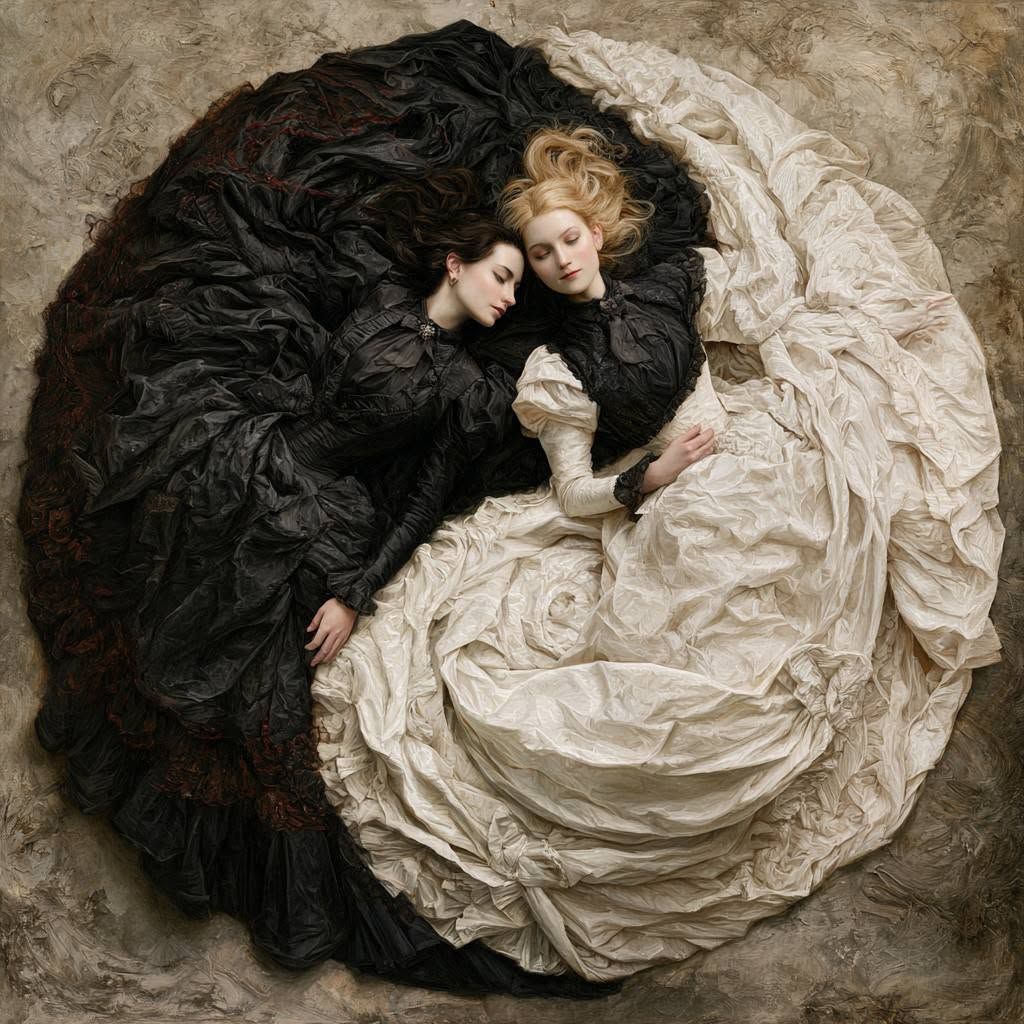
Their warm light illuminated two women asleep upon the floor. One wore black. The other wore white. Their skirts pooled outward across the floor in such a way that the fabric formed a single circle divided between darkness and light.
At first, the women simply slept, but later they whispered to one another in the shadows, late at night.
And then they sang.
The melodies sounded oddly familiar, stirring memories the dressmaker could almost reach but never quite actually touch. Certain phrases would also linger long after waking, following the dressmaker through the day like fragments of half-forgotten prayers until they evaporated in the afternoon sun.
And as autumn deepened, the dreams grew clearer. The women began speaking directly to her, as well.
"Is it finished yet?" asked the woman in white one evening, smiling as though picking up the thread of a conversation interrupted only moments earlier.
"Almost," replied the dressmaker.
The woman in black laughed softly and knowingly. "Yes, well, you always have taken your time."
The remark carried the comfortable warmth of an old joke shared countless times before, yet the dressmaker remained absolutely certain she had never met either woman. That certainty even managed to last until the evening she expertly secured the very last button to the white gown.
But then the needle slipped. A single drop of blood touched the silk, and the workshop disappeared.
Once again, the dressmaker stood within the lantern-lit chamber, but this time the women were wide awake.
They sat facing one another at the center of the strange, vast circle formed by their beautiful gowns. Their expressions held neither surprise nor urgency, and they gazed upon the dressmaker with the affection one reserves for a familiar fellow traveler when a long-sought destination is finally near.
"You remember now," said the woman in white with a knowing nod.
And the dressmaker opened her mouth to protest, but the memory arrived before the words could form. A crossroads, and a long-ago decision. Two roads stretching toward the horizon in different directions.
One path led to marriage, children, and roots driven deeply into the earth of a single place. But the other sprawled beyond all the familiar known horizons toward solitude, art, travel, and color-soaked stories waiting to be written.
For years, she had believed life required choosing, as that is what she'd always been told. But now she understood something else entirely. Both roads continued, and both lives unfolded in parallel.
It was then that she understood the ethereal women in front of her represented possibilities carried forward rather than explicitly abandoned. One had known great loves and devastating losses, while the other had gathered freedom and loneliness in equal measure. Each possessed joys the other sometimes envied, and each carried sorrows the other had never experienced.
Together, the two lives formed a whole, and that realization settled over the dressmaker with the chilly certainty of snowfall.
"I made your dresses," she whispered, not knowing quite what else to say. The women exchanged knowing smiles.
"You always do," said the woman in black.
And only then did the dressmaker notice a third figure standing nearby.
An elderly woman watched from the edge of the pool of lantern light, her flowing silver hair framing a familiar face. Time had softened its features, of course, but recognition still arrived nearly instantly.
The dressmaker was seeing herself, or rather, a version of herself waiting somewhere ahead, and the older woman smiled knowingly.
"The dresses were never for them," she said.
The dream dissolved, as even the most vivid dreams always eventually do, and morning sunlight streamed through the workshop windows. The black gown and the white gown stood draped over the forms of neighboring mannequins, finished at last.
Between them lay a small card written in elegant script with four words scrawled across its surface:
For when the journey ends.
The dressmaker read them once, and then again. Outside, church bells marked the hour as they would have on any other day. The local merchants opened their shops, wagons rattled across cobblestones, and somewhere out there, a dog barked at passing shadows.
Life continued.
Yet every evening thereafter, before extinguishing the lamps, the dressmaker paused for a heartbeat or two beside the two gowns. Because the strange thing about them was that dust never settled on their fabric, and time never touched the gem-like brilliance of their colors.
They simply waited with endless patience, as though they understood something the dressmaker herself had only begun to learn.