On Discovering Flannery O’Connor When You’re Finally Old Enough to Appreciate Her
A reflection on timing, obsession, and the fear that there are more good books than years left to read them

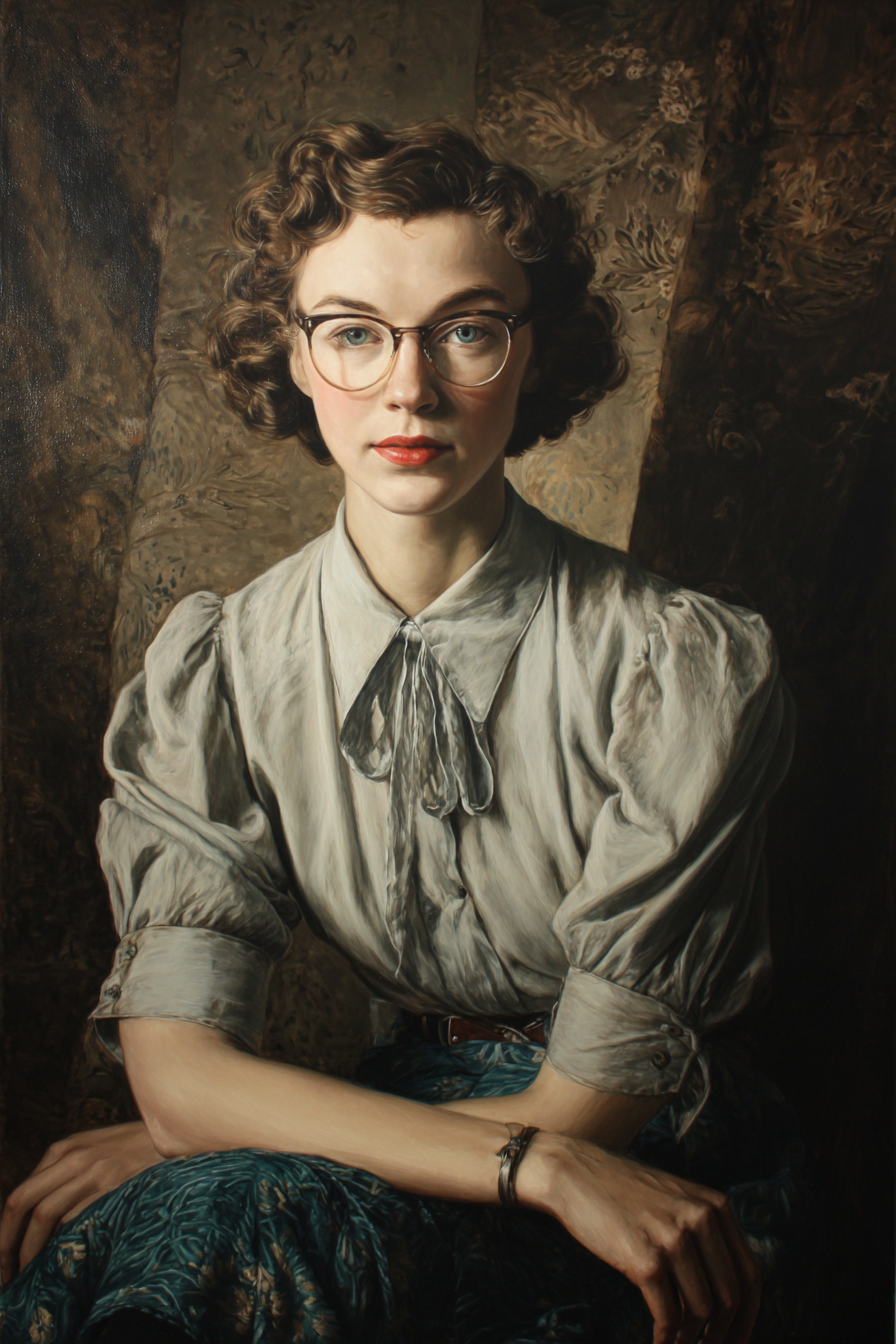
So, a few weeks ago, Seth casually recommended that we watch Wildcat, Ethan Hawke’s 2023 film about Flannery O’Connor. You know, as one does when recommending something for a cozy night in. I thought we were about to watch a nice artsy biopic, maybe learn a little about an author I vaguely remembered from high school, and call it a night.
Instead, I found myself spiritually suplexed by a Catholic mystic with a typewriter.
Seriously, I don’t know what I realistically expected from a literary biopic directed by Ethan Hawke and starring his daughter, but certainly not a cinematic séance where Flannery herself climbs out of the screen, sits down beside me, and goes, “So, why haven’t you been reading me all these years?”
Because the film left me with the impression that O'Connor was someone I actually could have been in another life. I related deeply to the fictionalized version of her, and as is often the case with really well-made biopics, I walked away wanting to know a lot more about her.
So, naturally, I handled this by spending the next few weeks devouring her stories like a woman possessed, because you know I love a good obsession.
That's probably fortunate for me, because Flannery O'Connor isn't really a “read one story and move on” type of writer. She’s the type who tilts your worldview three degrees to the left and forces everything around you to look different, ready or not.
A Little About Flannery
Born in Savannah, Flannery O'Connor spent most of her life in Georgia, living on a farm with peacocks, devout Catholic guilt, and a chronic illness (lupus) that tried very hard to slow her down. She died young, at only 39, but not before writing some of the most deliciously strange, morally sharp, spiritually unsettling stories ever published in America.
Her fiction blends grace, violence, humor, grotesque characters, biblical symbolism, and the deeply Southern ability to roast someone within an inch of their life while technically talking about God. She also clearly believed that sometimes you have to hit a reader with a metaphorical two-by-four before they’ll notice the universe is trying to tell them something, and I respect the hell out of that.
People call her a “Southern gothic” writer, but that doesn’t quite cover it. She’s more like a medieval theologian reincarnated into the body of a 1950s woman who just happened to also have a bird sanctuary and zero patience for sentimentality.
Reading her feels like attending a revival preached by someone who knows exactly how human nature works and isn’t shocked by any of it. She understood sin, grace, absurdity, and the sheer comic tragedy of being alive. And she wrote it all with the confidence of someone who never once felt the need to apologize for her interior world.
Probably exactly why her writing rearranged mine.
Meeting Flannery When You're Old Enough to Get It
This whole Flannery O'Connor thing I have going on right now is just as much about the timing as it is about the strange brilliance of her actual work. Because I have the feeling Flannery O’Connor wouldn’t have done much for me when I was eighteen.
I mean, God bless that era of my life, but I was mostly busy writing angsty poetry, obsessing over my hair, and thinking everything deep had to bring an "aesthetic" to the table in order to be relevant to my life.
But Flannery writes like a woman who stared down God, nodded politely, and then sat back down to rewrite Him with better dialogue. That's something I'm much better equipped to appreciate at nearly 50.
Her characters are grotesque, her worldview is razor-sharp, and her sense of humor falls somewhere between “morbid Catholic grandmother” and “Southern gothic trickster.” She was shaping stories out of grace, violence, absurdity, and spiritual dread long before those things were trending, and I'm 100 percent here for that at this stage of my life.
And I'm almost ashamed to say I don’t think I could’ve handled her before now, but there it is, just the same. I don’t think I had enough miles under my belt yet.
When Art Arrives Late (But Perfectly on Time)
At this point, I'm all the way through O'Connor's collection A Good Man Is Hard to Find and Other Stories and into her complete collected stories (skipping over the ones I already read in Good Man). And the more I read, the more I realize some artists truly don’t show up until you’re actually ready for them.
It’s not that they weren’t always there. It’s that you weren’t always the person who could receive them on the level you both deserve.
There are writers I adored in my teens that don't do anywhere near as much for me now, just as there are films I found boring at 25 that now hit me with existential resonance. (Lost in Translation, I'm looking at you!) Our taste evolves as we do, and that's something I've learned to embrace as I age.
Flannery arrived at a moment when I could fully relate to her — her oddness, her precision, her confidence in her own interior world, her refusal to pretty things up to make the reader feel better. Her work is a bit like spiritual sandpaper, smoothing down the places where you’ve gotten complacent over the years (and boy, have I).
Cue the Existential Panic Spiral
Lately, it seems that any time I discover a new writer, director, musician, or artist to love — especially one who's existed for a long time and has an extensive body of work to their credit — I instantly have one of my little existential mini-crises.
By that, I mean I start asking myself questions like:
- “Wait. How many other writers are out there waiting to rearrange me like this?”
- “How many do I have time left to discover?”
- “Oh God, I need to make a list.”
- “Why is every list of canonical authors so long?”
And then, the grand finale, which is always exactly the same no matter what type of media we're talking about:
I am mortal. I will never be able to discover every great thing out there before I eventually croak.
Nothing prompts a mild existential crisis quite like realizing there are more extraordinary books in the world than your remaining lifespan can reasonably accommodate. And naturally, instead of this motivating me to read faster, it usually just makes me want to lie facedown on the floor for ten minutes.
Because I am getting older, and the years are picking up speed at a nauseating pace. And every time I fall headfirst into a new artistic obsession, I feel this mix of exhilaration and urgency, like I’m glimpsing a door that’s been waiting for me, but also noticing the hallway isn't anything close to infinite.
But I suppose it's the most human thing in the world to worry about running out of time to experience the things that make life feel big. Especially when so much of adulthood feels so very small — errands, responsibilities, tending to crises you didn’t ask for.
And especially dealing with moments like the one I had yesterday, where your elderly mother falls (again) and your entire day is swallowed by chaos. But that may be a conversation for an entirely different day.
So Where Does That Leave Me
Well, for one, in the middle of a Flannery O’Connor spiral that doesn’t appear to be ending anytime soon. Wildcat was at least a couple of weeks ago by now, but I’m still neck-deep in her stories, reading about her life, marveling at her letters, and appreciating her absolute refusal to soften her voice to make people comfortable.
But I’m also thinking a lot about the way art finds us. How it helps an otherwise mundane life feel suddenly bigger again and reaffirms that there is always more incredible art out there to discover.
I'm hoping that if there are still many, many Flannerys out there waiting for me (and I strongly suspect there are), maybe I’m not running out of time in quite the way I think I am. Maybe I’m just at the next checkpoint on a planned cosmic itinerary, someplace a whole new selection of artists is scheduled to finally appear.
In the meantime, I’ll keep following these strange little obsessions as they come. Because if there’s one thing Flannery O’Connor teaches us, it’s that grace arrives in the most unexpected forms — sometimes simultaneously grotesque and beautiful, sometimes wrapped in dark humor and a chicken farm (with bonus peacocks!).
And all of this because Seth said, “Hey, do you want to watch this movie tonight?”